

Founder, Doon Digital
Save this article to read later and share with your network
Directory and Article Submission in 2026: Dead, or Just Misused?
By Pankaj Singh, founder of Doon Digital.
Here is the verdict before the article, because burying it would waste your time. For ranking, directory and article submission do almost nothing in 2026. We tested both on our own site and measured the result, and we are going to show you the numbers including the ones that are uncomfortable for us. There is one narrow case where directories still pay, it is worth understanding, and it is not the case the lists are selling. Both our directory and article submission lists are free at the end, and we will tell you plainly how to use them.
What these two tactics were built for
Both come from an era when search engines could not judge a page very well on its own merits, so they leaned heavily on who linked to it.
Directory submission meant adding your business to a categorised index. In the early web this was genuinely how people found sites. Yahoo started as a directory, not a search engine. Getting listed meant discovery, and the link came along with it.
Article submission meant writing a short piece, publishing it on a site that accepted submissions from anyone, and including a link back in an author box. EzineArticles and its imitators ran on this. For a while it worked well enough that an entire industry existed to spin one article into forty near-identical versions.
Both tactics shared an assumption: that a link is a vote, and more votes are better. That assumption held for roughly a decade. It has not held for considerably longer than that, and yet the lists are still sold on it.
What changed, and when
The guidance, and what it actually targets
Google's position on link schemes has been consistent for years. What it targets is not directories or articles as formats. It targets links created primarily to manipulate rankings, whatever they look like. A directory listing you made yourself, on a site that accepts everyone, exists for exactly one reason and that reason is visible.
The important nuance is that these links mostly do not get you penalised. They get ignored, which is a different and more common outcome. You do the work and nothing happens. No warning, no message in Search Console, just no effect.
Why reciprocal and paid directories went first
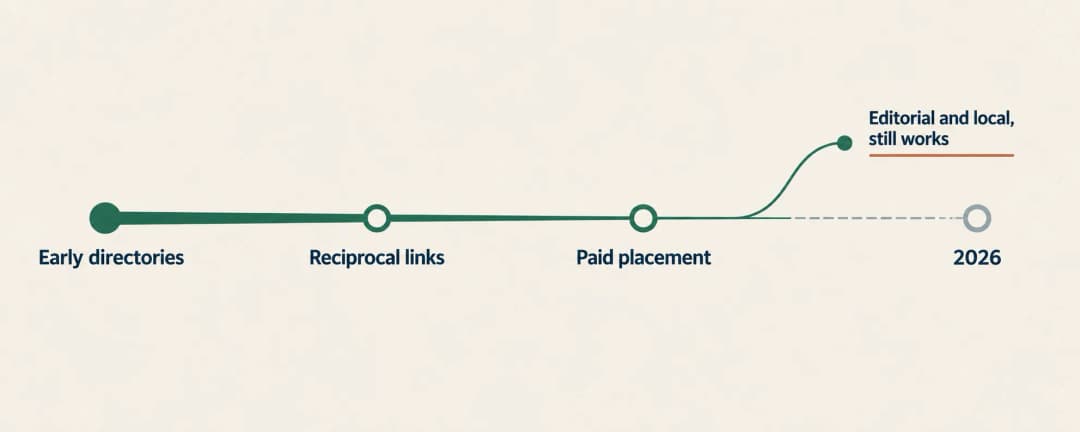
The directories that lost value earliest were the ones with the clearest transaction: pay a fee and get listed, or link back to us and we will link to you. Both are trivially detectable at scale, and both stopped working long before the general-purpose directories did.
What survived longest were directories with editorial judgement, where somebody genuinely decides whether you belong. There are still a few. They are also the ones that are hard to get into, which is not a coincidence.
The 22-domain network we walked into
In August and September 2026 we submitted our own site to 24 directories. Twenty-two different domain names, and every single submission landed at a URL of the same shape: /listings followed by seven or eight digits.
Look at the names together and the picture completes itself:
directoryalbum.com, directoryhand.com, directoryrec.com, directoryforever.com, emeralddirectory.com, socdirectory.com, victorydirectory.com, yourtopdirectory.com, oxodirectory.com, isitedirectory.com, dotcom-directory.com, orange-directory.com, golinkdirectory.com, real-directory.com, mydirectorys.com, adirectoryplace.com, feeldirectory.com, weballdirectorys.com, ukdirectorylist.com, directory-fast.com.
And then, submitted on the same day: directory-legit.com and legit-directory.com. The same operator, running the same word order backwards, twice.
Our reporting tool counted 22 referring domains. It is one source with 22 names, and the pattern is visible from the address bar.
What we measured
The links, and the null result
The 24 directory submissions were part of a wider programme of 293 links across 15 days, which also included 89 bookmarking submissions and 14 classified listings. We tracked 242 keywords in Search Console daily for three weeks.
No keyword we target moved into a better position. Authority Score sat at 6 before and 6 after. Referring domains at the quality threshold that actually moves that score, 21 and above, stayed at 11 throughout. Site-wide referral traffic in the five days after the programme finished was 3 sessions.
The only visible effect was a crawl surge: impressions rose from about 210 a day to 631 for three days, then returned to baseline within 24 hours.
The uncomfortable part
In the same 30-day window, nine of our primary commercial keywords fell, several of them badly.
| Keyword | Before | After |
| best digital marketing agency in dehradun | 31.2 | 43.8 |
| digital marketing in dehradun | 45.9 | 58.3 |
| digital marketing service in dehradun | 42.9 | 54.3 |
| digital marketing services in dehradun | 36.9 | 47.0 |
| best digital marketing company in dehradun | 26.8 | 36.2 |
| digital marketing agency in dehradun | 35.7 | 42.7 |
Impression-weighted across the whole tracked set, the net movement was negative 4.5 positions.
What we cannot prove, and why we are saying so
We cannot prove the links caused that, and we are not going to claim it.
Three things happened in the same window. We shipped five new page routes. Semrush's own difficulty score for one of those keywords moved from 47 to 30, which means the results page itself changed composition. And a 30-day average against another 30-day average is a blunt instrument.
So the honest position is: an entire semantic cluster moved the same direction at once, which random volatility does not usually do, in the same window that 171 network links landed. That is suggestive and it is not proof.
What separates the two explanations is time. Ordinary volatility recovers on its own. Link damage does not. We are rechecking, and if the cluster has not recovered we will say so here.
We are publishing this mid-experiment rather than waiting for a clean story, because an article about link building that only shows the wins is the exact thing this article is warning you about.
The narrow case where directories still pay
Having said all of that, we have not deleted the lists, and there is a real reason.
Citations are a different job from links
A directory or business listing has two separate functions that get confused constantly.
As a link, it is worth roughly nothing, as above.
As a citation, it is worth a great deal if you are a local business. A citation is a consistent mention of your name, address and phone number on another site, and Google uses the consistency of those mentions as a strong input into local map ranking. Unlike link building, volume genuinely helps here.
That is the narrow case. A local directory carrying your correct details is doing citation work, not link work, and it should be judged on that.
The corollary matters more than the tactic. An inconsistent citation actively hurts. When our office moved in August 2026, all 42 of our existing listings became wrong overnight, and correcting them mattered considerably more than adding new ones.
The genuinely useful directories
They exist. They share three traits: somebody reviews submissions, there is a reason for the directory to exist beyond hosting links, and getting in takes more than filling a form.
For a business like ours that means the reviewed B2B directories, industry bodies and chambers of commerce, and real local and regional indexes. A dozen of those is worth more than every entry in a 500-site list.
The AS 21+ test
Here is the single filter we now use, and it settles most arguments quickly.
Look at the Authority Score of the domain, and ignore anything below 21. Not because 21 is magic, but because that is roughly where our own gap sits: we have 11 referring domains at AS 21 or above, and the competitors outranking us in this city have between 19 and 37. Closing that gap is the thing that would actually move our rankings, and no amount of directory submission contributes to it.
Twenty-four directory links moved that number from 11 to 11.
If you are going to do it anyway
Some of you will, and there are sensible ways to do it.
Do it for citations, not links. That means local and industry directories where your business details appear, and it means getting the details identical everywhere. Decide the exact string for your name, address and phone, write it down, use it every time.
Check for the network before you submit. Open three listings on the site and look at the URL shape. If a dozen sites on your list share it, treat them as one and pick the best.
Cap it. Ten to fifteen genuinely different directories. Working down a list of 500 produces a footprint, not a result.
Never point a money anchor at one. An exact-match commercial phrase on a directory listing is the clearest manipulation signal there is, and a site with low authority has no buffer to absorb it. We have two of those live from our own batch and we are pulling them back.
For article submission specifically, write one good article and place it once. The spun-across-forty-sites model is dead and has been for years. If the piece is good enough to publish somewhere real, publish it somewhere real.
Our lists carry 180 directories and 160 article submission sites, every URL opened and confirmed loading, with our own Moz figures rather than the invented ones that travel with these spreadsheets.
What to do with the hour instead
The honest alternative is less satisfying to count, which is precisely why people do directory submission instead.
Fix what a crawl of your own site tells you. Usually cheaper and faster than any link.
Get your Google Business Profile genuinely complete. For a local business it outperforms every directory on our list combined.
Earn a small number of real editorial links. Five strong referring domains a month beats five hundred weak ones. One competitor we measured has 932,000 backlinks and an Authority Score of 8. Another has 322 referring domains and a score of 21. Volume is not the variable.
That last one is what off-page SEO actually means, and it is slower than everything above.
We wrote up what the rest of the programme returned too: social bookmarking, profile creation and classified sites.
FAQ
Is directory submission still useful for SEO in 2026? For rankings, essentially no. Our 24 submissions produced no position change and left our AS 21+ referring domain count at 11. For local citations it still works, and that is a different job judged on consistency rather than links.
Does article submission still work? Not in the spun, mass-submitted form it was built for. Writing one genuinely good piece and placing it on a site with editorial standards works, but that is guest posting, not article submission.
How many directories should I submit to? Ten to fifteen genuinely different ones, chosen for citation value. Check the URL pattern first so you are not submitting to the same platform twelve times.
Will directory submission get me penalised? Usually not. The far more common outcome is that the links are ignored, which is why people keep doing it: nothing bad happens, and nothing good does either. The real risks are footprint at volume and exact-match anchors.
What is the difference between directory submission and local citations? The format overlaps; the purpose does not. A link chases authority. A citation chases consistency of your business details, which feeds local map ranking. The same listing can do one, both or neither.
What should I do instead? A complete Google Business Profile, consistent business details everywhere, and a handful of genuinely earned editorial links each month. Harder to report on, and it is the part that works.
---
Doon Digital is an SEO company in Dehradun working across Uttarakhand since 2019. We publish our own results, including the ones that did not work.
Need help with what you just read?
Doon Digital can implement these strategies for your Dehradun business. Pick what fits.
SEO Services Dehradun
Page 1 Google rankings for local + national keywords.
Learn moreCase Studies
30+ case studies with real metrics and live links.
Learn moreFree Marketing Audit
5-page written report with what to fix first.
Learn moreCompare Dehradun Agencies
Seven Dehradun agencies compared on real rankings, us included.
Learn moreRelated Articles
Explore more insights from Doon Digital
Guest Posting That Still Works: A Link Builder's Filter
Instant approval is a contradiction in terms. Here is the nine-point filter we use instead, why guest posting is the only tactic that moved our Authority Score, and how to pitch so an editor says yes.

Free Classified Sites in India: Which Ones Still Bring Enquiries
Most classified site lists are written for SEOs collecting links. This one is written for a business owner who wants the phone to ring, with what our own 14 submissions actually returned.
What Social Bookmarking Actually Does for SEO in 2026
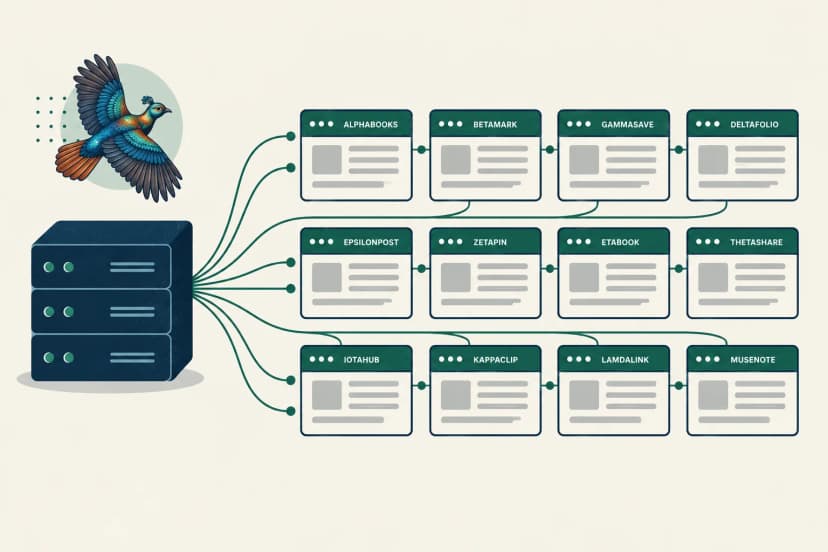
We submitted to 89 social bookmarking domains in 15 days and tracked every keyword. Here is what actually moved, what did not, and how to spot a bookmarking farm before you waste a weekend on it.
Pankaj Singh
Founder, Doon Digital
Founder of Doon Digital. SEO and PPC for Uttarakhand businesses since 2019.