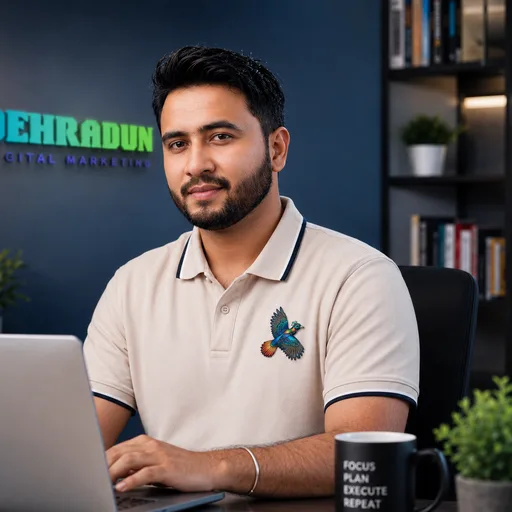
Founder, Doon Digital
Save this article to read later and share with your network
SEO + Google Ads Run Together: Why Each Costs Less
By Pankaj Singh, founder of Doon Digital.
Most Dehradun business owners think of SEO and Google Ads as competing budget items. "Should I do SEO or Ads?" is the framing.
It's the wrong framing. SEO and Google Ads together, when properly integrated, produce compounding results that neither channel achieves alone. The same total budget split across both produces more leads, lower cost per lead, and better data than putting it all into one channel.
Here are the 6 specific ways they reinforce each other, with real numbers from Dehradun engagements I've run since 2019.
Synergy 1: Ad data accelerates SEO keyword discovery
SEO without paid data is guessing. You spend 4 months ranking for a keyword, then discover it doesn't actually convert.
Google Ads, run for even 30 days, tells you exactly which keywords convert and at what rate. You don't have to wait 4 months. The data lands in days.
How this works practically:
- Run a Google Ads test for ₹25,000 over 30 days targeting 30 to 40 keyword variations
- After 30 days, look at conversion data per keyword
- Identify the 5 to 10 keywords with the highest conversion rate
- Build SEO content specifically around those keywords
When Skill-ed launched, we used this pattern. Initial Google Ads spend revealed that "AI course Dehradun" and "skill development training online" converted at much higher rates than the generic terms originally planned. SEO content got built around those proven converters. Within a quarter, organic search visibility for AI and skill-development keywords climbed substantially.
Without ads data, the SEO content would have targeted the wrong terms for 6 months.
Synergy 2: SEO rankings reduce Google Ads CPC over time
Google's Quality Score factors in landing page experience. Pages that also rank organically for the keyword they're advertising on get higher Quality Score, which lowers CPC.
The mechanism:
- Your landing page ranks #4 organically for "dental clinic Rajpur Road"
- You also bid on that keyword in Google Ads
- Google sees that your page is "deserving" of the keyword (it ranks for it organically)
- Quality Score on the ad goes up
- CPC drops by 20% to 40% over 60 to 90 days
I've seen Dehradun clinics where the CPC on their top 5 keywords dropped from ₹45 to ₹22 over 90 days, purely because organic rankings on the same keywords improved.
This effect compounds: every keyword you rank well for organically becomes a cheaper paid keyword.
Synergy 3: Brand search protection
When someone searches your business name on Google, what shows up?
If you don't bid on your own brand:
- Competitors can bid on your brand name and appear above your organic listing
- A "Doon Dental" search shows a "Smile Care Dehradun" ad on top
- That competitor steals your customer at the exact moment they're trying to find you
Brand search ads typically have very low CPC (₹3 to ₹15 in Dehradun, because nobody else can bid as profitably on your brand) but extremely high conversion rate (15% to 30%).
Practical setup:
- Run a small ongoing campaign on exact-match queries: your business name, your business name + Dehradun, your business name + service
- Budget: ₹200 to ₹500 per day, depending on brand search volume
- Goal: occupy position 1 ad slot on every brand search, push competitors below the fold
This is cheap insurance against competitor poaching. Most Dehradun businesses don't do it. Their competitors do.
Synergy 4: Geographic coverage doubles
SEO is best at ranking for queries that include city or area names: "dentist Rajpur Road", "interior designer Dehradun". These have explicit geographic intent.
Google Ads is best at targeting queries without geographic specifiers, using audience-level geo-targeting: someone in Dehradun searching just "dentist" or "interior designer" without specifying location.
Together they cover both query types. SEO alone misses the unspecified-location queries. Ads alone misses the high-converting hyperlocal queries.
When Hurla Interio integrated SEO with Google Ads, we did this exact coverage. SEO targeted "modern kitchen interiors in Dehradun", "modular wardrobes Rajpur Road", "office interior design Dehradun". Ads targeted broader queries like "interior designer", "kitchen renovation", "modular wardrobe" with geo-targeting to Dehradun area. The two channels caught different segments of the same buyer journey. Result: 70% increase in qualified consultation inquiries within 5 months.
Synergy 5: Remarketing on SEO traffic
This is where the magic happens. Most of your SEO traffic doesn't convert on the first visit. They land, browse, leave. In a single-channel world, they're gone.
In an integrated world:
- They land on your page via organic search
- A remarketing pixel tracks them
- For the next 7 to 30 days, they see your ads on Google Display Network, YouTube, partner sites
- Eventually they come back and convert
The math:
- 1,000 SEO visitors per month
- 5% convert on first visit (50 conversions)
- Without remarketing, the other 950 are lost
- With remarketing, an additional 10% to 15% convert on follow-up visits (95 to 142 more conversions)
- Remarketing CPC is typically 60% to 80% lower than cold traffic CPC
SEO and remarketing together produce 2 to 3x the conversions of SEO alone. The remarketing budget is small (₹3,000 to ₹15,000 per month for most Dehradun service businesses), and the unit economics are excellent.
Synergy 6: Cross-channel learning loops
Every channel teaches you something the others can't.
Search Console (SEO) tells you: what people are searching for, what they're clicking, where the gaps are.
Google Ads tells you: what people are willing to pay for, what converts, what message resonates.
Combined, they tell you: which messages work for both informational and transactional searches, where to invest content next, how to position the business.
Most Dehradun businesses pull insights from only one channel. The agencies that integrate SEO and PPC for clients pull insights from both, which is why those clients outperform.
The budget split that works for most Dehradun SMBs
If you're starting from zero with a ₹50,000 to ₹100,000 monthly marketing budget, here's what I'd allocate:
Months 1 to 3 (foundation phase):
- ₹15,000 to ₹25,000 on Google Ads (testing keywords, generating immediate leads)
- ₹15,000 to ₹30,000 on SEO (content, technical, GBP work)
- ₹3,000 to ₹8,000 on remarketing (Display + YouTube)
- ₹2,000 to ₹5,000 on tools (Search Console, GA4, Looker Studio dashboard)
Months 4 to 6 (scaling phase):
- Increase whichever channel is producing the best unit economics
- Typically Google Ads scales first because it produces faster, then SEO compounds later
- Maintain remarketing at 5% to 10% of total
Months 7 to 12 (compounding phase):
- SEO starts producing the cheapest leads
- Google Ads remains for fast-response and hard-to-rank queries
- Remarketing grows as organic traffic grows
- Budget reallocates toward whichever channel produces lowest cost per qualified lead
The ratio that consistently works long-term for Dehradun service businesses: roughly 40% SEO, 40% Google Ads, 15% remarketing, 5% other (tools, experimental channels).
When integration doesn't work
Two scenarios where running both channels actively isn't the right move.
Scenario 1: Total budget below ₹25,000 per month. Splitting this across both channels means neither gets enough to produce results. Pick one. Usually Google Ads for fast cash flow, then SEO once the business is funded.
Scenario 2: One person managing everything part-time. Running both channels well requires consistent attention. If you only have 4 hours a week, one channel managed well beats two channels managed poorly. Pick the one that matches your business decision window (see SEO vs Google Ads for Dehradun: Real Cost Per Lead Compared for the framework).
What real integration looks like for a Dehradun clinic
Just to make this concrete, here's how I'd structure an integrated SEO + Ads campaign for a typical Dehradun dental clinic:
Google Ads layer:
- Brand campaign: clinic name variations, ₹300 daily budget
- Service campaigns: separate campaigns for cleaning, root canal, implants, cosmetic dentistry
- Hyperlocal campaign: Rajpur Road, Ballupur, Pacific Mall area-specific queries
- Remarketing layer: visitors who viewed pricing or services pages
SEO layer:
- Google Business Profile fully optimized with WhatsApp integration
- 5 service landing pages, each Dehradun-anchored
- Hyperlocal "near me" pages for top 3 service areas
- Pillar guide: "Choosing a dentist in Dehradun: a 2026 guide"
- FAQ blocks with schema on every page
- Active review collection (4 to 8 fresh reviews per month)
Shared infrastructure:
- WhatsApp Business with 5-minute reply SLA
- Conversion tracking unified across both channels
- Monthly review of which channel produced which lead source
This structure produces leads from day 1 (Ads), grows steadily through month 6 (SEO compounding), and reaches a steady-state where the clinic gets 60% of leads at SEO economics and 40% at Ads economics.
For the underlying decision of whether your business should run PPC at all, see SEO vs Google Ads for Dehradun: Real Cost Per Lead Compared. For the operational cadence to keep both channels healthy, see How Often to Check and Tweak PPC.
Pankaj Singh is the founder of Doon Digital. He has run SEO and PPC campaigns for 200+ businesses across Uttarakhand since 2019.
Need help with what you just read?
Doon Digital can implement these strategies for your Dehradun business. Pick what fits.
PPC Expert in Dehradun
Certified Google Ads + Meta Ads specialists. 3-5x ROAS.
Learn morePPC & Google Ads
ROAS-focused paid campaigns with daily optimization.
Learn moreSEO Services Dehradun
Page 1 Google rankings for local + national keywords.
Learn moreCase Studies
30+ case studies with real metrics and live links.
Learn moreRelated Articles
Explore more insights from Doon Digital
5 Local SEO Services Secrets to Rank Higher in Google Maps
Discover five practical Local SEO Services secrets to boost your Google Maps ranking and attract more nearby customers in Dehradun and Uttarakhand.
How to Optimize Performance Marketing Campaigns Efficiently
Ads spending but results flat? The problem is usually the optimization sequence, not the channel. How to fix campaigns in the right order.
How Often to Check and Tweak PPC Campaigns
The exact PPC management cadence that produces ROAS for Dehradun businesses. What to check daily, weekly, monthly, and what to ignore.
Pankaj Singh
Founder, Doon Digital
Founder of Doon Digital. SEO and PPC for Uttarakhand businesses since 2019.